
PIEAS Aggregate Calculator
FSc: 60% test percentile, 25% FSc Part-I, 15% Matric. O/A Level: 60% test, 40% O-Level.
Last updated · Page editedHow PIEAS calculates your merit
PIEAS ranks BS applicants on the written test (60%), HSSC Part-I (25%) and SSC (15%). The test counts as a percentile, which shows where you stand against the other candidates, not your raw marks. O and A-Level students get the whole 40% academic share from their O-Level equivalence.
FSc and Matric students
Aggregate = (Test percentile × 0.6) + (FSc Part-I % × 0.25) + (Matric / SSC % × 0.15)
- 60% PIEAS test percentile.
- 25% FSc Part-I marks.
- 15% Matric (SSC).
O and A-Level students
Aggregate = (Test percentile × 0.6) + (O-Level % × 0.4)
- 60% PIEAS test percentile.
- 40% O-Level marks from your IBCC equivalence.
Which marks to enter
- Test: your percentile from the PIEAS portal, not your raw marks.
- FSc: your Part-I marks and Part-I total, even if Part-II is out.
- O and A Levels: pick O/A Level and enter your O-Level IBCC equivalence marks out of 900. No certificate yet? Use the IBCC equivalence calculator.
- SAT II or ACT: PIEAS keeps some seats on a separate SAT II / ACT list. This calculator doesn't cover that route.
Worked example: PIEAS merit for engineering
| Part | Working | Points |
|---|---|---|
| Test percentile 80 / 100 | 80% × 60% | 48.00 |
| FSc Part-I 470 / 550 | 85.45% × 25% | 21.36 |
| Matric / SSC 1000 / 1100 | 90.91% × 15% | 13.64 |
| PIEAS aggregate | 83.00% | |
You also need at least 60% in both Matric and Intermediate. Less than 60% in SSC or HSSC Part-I/II makes you ineligible.
PIEAS closing merit
PIEAS doesn't publish closing aggregates. After the second test it announces a merit number for each candidate on the admission portal, then fills seats through a series of merit lists. In 2026 the merit number came out on 20 July and seven merit lists followed, from 27 July to 1 September.
Your merit number is what decides your seat, and you can update your degree preferences for a short window after it is announced (20 to 21 July in 2026).
PIEAS test pattern and papers
The test has 100 multiple choice questions in 3 hours with no negative marking. You choose the paper that matches your FSc subjects:
- Pre-Engineering: Maths 30, Physics 30, Chemistry 30, English 10.
- Pre-Medical (CIS and Physics): Maths (SSC level) 30, Physics 30, Chemistry 30, English 10.
- ICS: Maths 30, Physics 30, Computer Science 30, English 10.
- General Science with Maths (CIS only): Maths 60, Physics (SSC level) 30, English 10.
PIEAS holds the test twice in each cycle. In 2026 the first test was on 12 April in 18 cities and the second on 12 July in six cities.
PIEAS aggregate and eligibility by programme
All BS programmes use the same merit formula. To apply you need at least 60% in both Matric and Intermediate:
- Engineering (Chemical, Electrical, Mechanical, Metallurgy & Materials): Pre-Engineering or ICS. Pre-Medical students who passed additional Maths and DAE holders can also apply.
- Computer & Information Sciences and Physics: Pre-Engineering, Pre-Medical or ICS. General Science students with Maths can apply for CIS.
There are no reserved or quota seats; everyone must pass the PIEAS test.
How the PIEAS test and Part-I marks work together
The test is 60% of the merit and is scored as a percentile, so it measures your standing against other candidates.
1. Two test chances a year
PIEAS runs a first and a second test. Each needs its own application fee, and the fee for one test can't be moved to the other.
2. Part-I, not Part-II
HSSC Part-I carries 25%, so your merit is fixed before Part-II results. You still need 60% in the final result to join.
3. Pick the right paper
There are four papers for Pre-Engineering, Pre-Medical, ICS and General Science. All have 100 questions, 10 of them English.
4. No quota seats
Candidates from Balochistan, former FATA and with disabilities who qualify the test may be admitted under HEC policy.
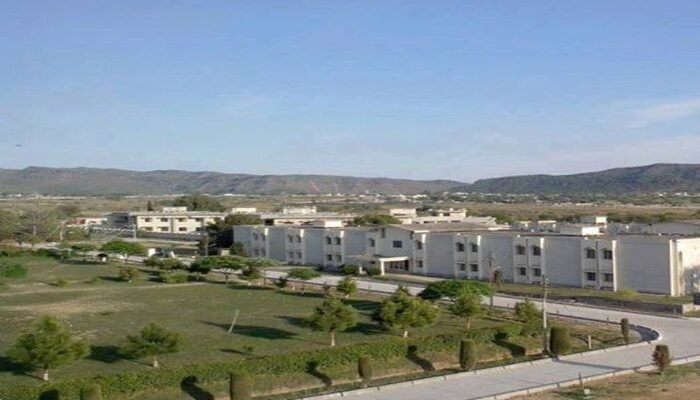 PIEAS, Nilore
PIEAS campus, Nilore, about 26 km from Islamabad. Photo: PIEAS.
PIEAS aggregate: common questions
How is the PIEAS aggregate calculated?
PIEAS uses 60% written test (percentile), 25% HSSC Part-I and 15% SSC. O and A-Level students get the whole 40% academic share from their O-Level IBCC equivalence.
Why does PIEAS use a percentile?
PIEAS converts each test score into a percentile, which shows the share of candidates you scored above. Your result on the PIEAS portal gives the figure to enter.
Is there negative marking in the PIEAS test?
No. The test has 100 multiple choice questions in 3 hours with no negative marking.
Does PIEAS use FSc Part-II marks?
No. The merit uses HSSC Part-I marks. You still need 60% in the final Intermediate result when you join.
What is the PIEAS closing merit?
PIEAS doesn't publish closing aggregates. It gives each candidate a merit number and fills seats through its merit lists.
Can I get into PIEAS with SAT II or ACT?
Yes, on a separate list mainly for overseas Pakistanis: SAT II of at least 2000 in three subjects, or an ACT composite of at least 25.
What is the minimum percentage for PIEAS?
At least 60% in both Matric and Intermediate (or O and A-Level equivalence).
Sources and calculation rules
Checked 19 October 2026 on the official pages: Information Leaflet for BS Admissions (PDF), Admission Schedule, BS programmes, Admission FAQs.
Enter your test percentile as shown on the PIEAS portal. The calculator shows the merit PIEAS's published formula gives; your merit number on the portal is final.
StudentPath is an independent guide. Confirm current admission requirements with the university.
Compare related calculators
Each university uses its own formula, so results are not interchangeable.